Thailand’s culinary landscape is not merely a collection of dishes; it is a sensory tapestry woven with fragrant herbs, fiery chilies, and the unmistakable umami of fermented fish. For the epicurean traveler, a cooking class vacation offers more than just recipes. It provides a visceral entry into the very soul of Siamese gastronomy. Imagine trading the sterile confines of a Western kitchen for a steamy, open-air pavilion overlooking rice paddies, the air thick with the perfume of lemongrass and kaffir lime. Here, you do not just learn to cook; you learn to taste the land itself.
The Alchemy of Som Tam: Unlocking the Green Papaya Salad
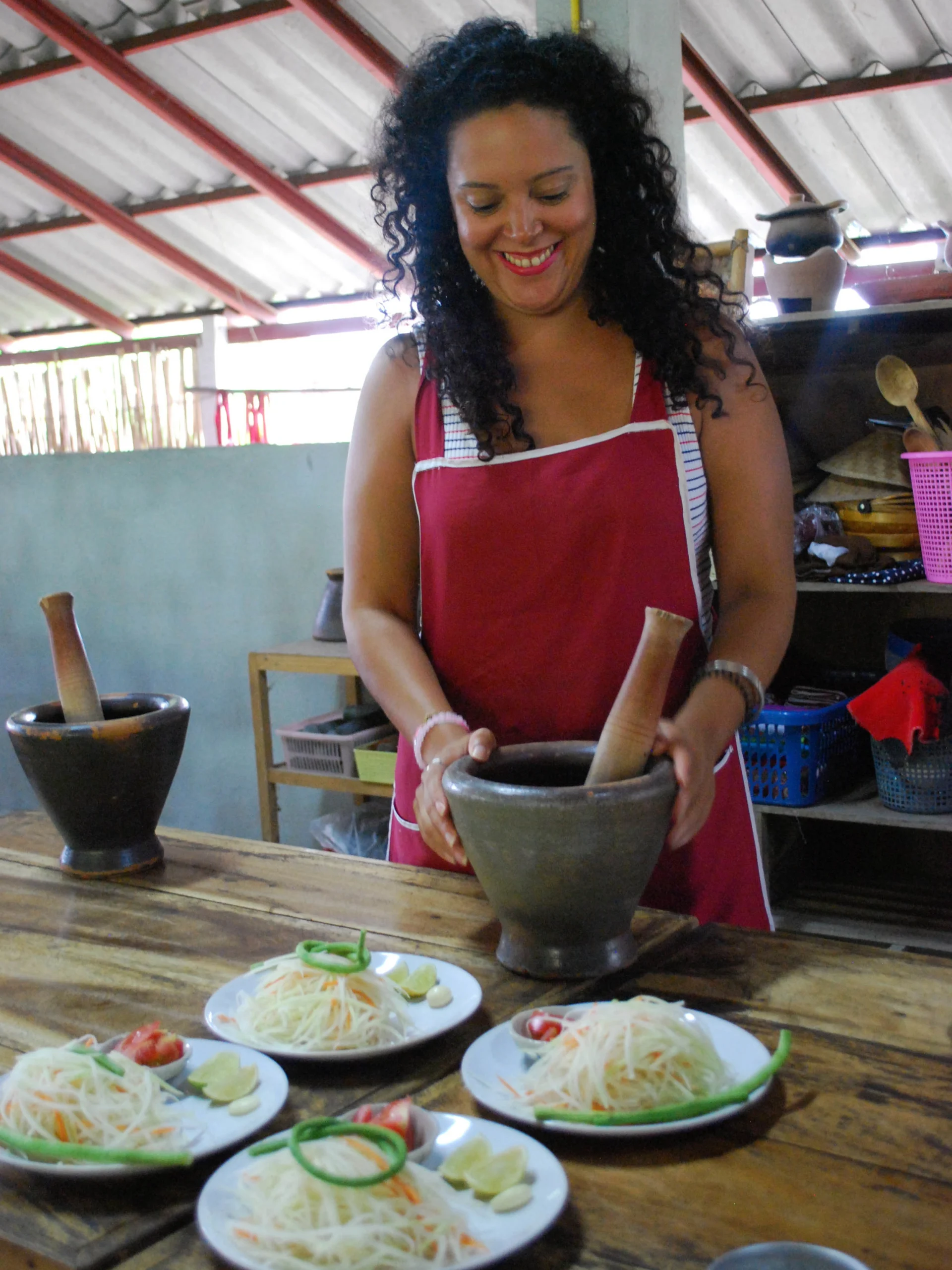
Few dishes embody the Thai balance of sweet, sour, salty, and spicy as perfectly as Som Tam. A proper class does not begin with a knife, but with a mortar and pestle—the *krok*—the true heart of this dish. You will learn the correct order of ingredients, a sequence as precise as a chemical equation. First, you crush garlic and bird’s eye chilies to a pungent paste. Then, you add palm sugar, tamarind paste, and fish sauce, bruising them against the sides of the vessel to release their volatile oils. The unripe papaya, shredded into impossibly thin filaments, is added last, tossed with a violent, rhythmic pounding that marinates every strand. You will discover why a *long bean* provides a superior crunch to a standard green bean, and why the inclusion of dried shrimp and roasted peanuts is non-negotiable for textural verisimilitude. This is not a salad; it is a percussive event, a symphony of flavor forged through impact.
Curry Pastes from Scratch: The Mortar-Borne Complexity
Forget the ubiquitous paste from a jar. A transformative class will force you to reconceptualize curry. You will spend a glorious hour at a granite mortar, reducing a galaxy of ingredients into a homogenized, aromatic paste. The process is methodical: you begin with the hardest, most resinous elements—galangal, lemongrass, and makrut lime zest—grinding them until they form a dry, fibrous mass. Then you incorporate the wet aromatics: shallots, garlic, and the potent, earthy flesh of fresh turmeric. Only after this foundation is laid do you add the dried red chilies, rehydrated and seething with latent heat. The result is a *gaeng* paste of such vibrant, raw potency that it seems to hum with energy. You will learn to differentiate between a *Gaeng Keow Wan* (sweet green curry) and a *Gaeng Phed* (red curry), understanding that the color is not merely aesthetic but a herald of the specific chili-to-herb ratio within. This alchemical process teaches patience; there are no shortcuts to true depth of flavor.
The Perfect Pad Thai: A Study in Chaos and Control
Contrary to its placid appearance, Pad Thai is a tempest in a wok. A masterclass in Thai stir-frying, or *pad*, demands you confront the terrifying beauty of the high-heat wok. You will learn the correct *mise en place*—everything prepped and ready, because once the rice noodles hit the searing metal, there is no time for hesitation. The technique involves a precise dance: the fat (rendered pork lard or vegetable oil), the egg (scrambled furiously to one side), the protein (shrimp or chicken), and finally the soaked, pliable noodles. The soul of the dish lies in the sauce—a clandestine blend of tamarind concentrate, fish sauce, and sugar, reduced until it glazes the noodles with a sticky, caramel-like sheen. A true instructor will guide you in achieving the elusive *wok hei*—that smoky, breath-of-fire essence that separates a home cook’s attempt from a street vendor’s masterpiece. You will garnish with bean sprouts, crushed peanuts, and a wedge of lime, understanding that these are not decorations but essential counterpoints to the unctuous noodles.
Navigating the Wet Market: A Foray into Fresh Ingredients
No thorough culinary vacation omits the market. Your class will likely begin at a local *talad* where the curriculum is written in the cries of vendors and the scent of rain-soaked herbs. You will learn to select a pomelo by its heft, to identify the subtle difference between holy basil (*bai grapao*) and Thai basil (*bai horapha*), and to haggle respectfully for a mound of tiny, iridescent river prawns. The market is your classroom for uncommon produce: the bitter gourd, the winged bean, the feathery dill that graces Laotian-influenced dishes. A knowledgeable guide will explain how the intensity of a shrimp paste changes based on its fermentation period, or how to pick a young coconut whose water is sweet and jelly tender. This sensory overload is not incidental; it is the foundation upon which your entire cooking is built. You taste the source of your ingredients, and that knowledge translates directly into the final dish.
From Farm to Table: The Ethical Component of Thai Gastronomy
An increasing number of programs now integrate a farm visit into the itinerary, offering a profound layer of context. You might find yourself walking through an organic coco-peat bed, harvesting your own long beans and Thai eggplants. You will hear about the symbiotic relationship between the rice paddy and the fish pond, and how the turmeric root you dig up is used not just for coloring but for its anti-inflammatory properties. This is more than a rustic photo opportunity; it is a lesson in *terroir*. Understanding that your *kao niew* (sticky rice) was soaked from grains grown in a specific province, or that your *prik kii nu* (mouse-dropping chilies) were hand-picked that morning, imbues your cooking with an ecological awareness. It moves the experience from simple replication to genuine stewardship, teaching you to respect the lifecycle of your meal.
Regional Variations: Beyond the Bangkok Pantheon
Thai cuisine is not monolithic. A superlative cooking vacation will expose you to its stunning regional diversity. In the north, around Chiang Mai, you might learn to make *Gaeng Hang Lay*, a Burmese-influenced pork curry featuring ginger, tamarind, and turmeric, slow-cooked until the meat yields like butter. Isan, or the northeast, offers a different logic: a world of grilled meats (*mo ping*), spicy and funky *larb* (a minced meat salad toasted with rice powder), and sticky rice. A class focused on the south, near Phuket or Krabi, will emphasize the intense heat and coconut-rich curries, like *Gaeng Som*, a sour-and-spicy fish curry that relies on the acidic punch of tamarind. These lessons dismantle the idea of a single “Thai” flavor, revealing instead a deliciously complex archipelago of taste.
Crafting the Complete Vacation: Structure and Cadence
A well-designed program is not a series of disjointed demonstrations. The best itineraries are structured like a multi-course meal. Your week might begin with knife skills and a market visit, progress through the mortar-and-pestle mastery of pastes, and culminate in a final “challenge” where you independently produce a full feast. Many villas and retreats offer morning classes followed by afternoon leisure—perhaps a massage or a swim in a waterfall—so you digest both the food and the experience. The cadence is crucial: you learn the science behind fermentation one day, and practice knife cuts the next. This deliberate pacing prevents overwhelm and allows the subtle, complex flavors of Thai cooking to truly permeate your psyche. You leave not with a cookbook, but with a set of ingrained, almost instinctual techniques. The final, communal meal—a feast of your own creation shared with newfound friends—becomes the ultimate testament to your journey, a delicious, fragrant memory of a place where every dish tells a story.