Embarking on a heritage travel journey through Africa is akin to stepping into an open-air museum, where each destination narrates a chapter of humanity’s grand tapestry. From the sun-baked dunes of the Sahara to the mist-shrouded highlands of Ethiopia, the continent’s historical and cultural landmarks offer more than mere sightseeing—they provide a visceral connection to the past. These sites are not just relics; they are living testimonies to civilizations that shaped the world, from the architectural marvels of ancient kingdoms to the spiritual sanctuaries carved into solid rock. Whether you seek the enigmatic gaze of the Sphinx, the rhythmic pulse of Swahili coastal trade routes, or the silent grandeur of rock-hewn churches, Africa’s heritage destinations promise an odyssey that transcends time. Below, we explore seven such extraordinary places, each offering a unique lens through which to understand the continent’s profound legacy.
The Timeless Allure of the Pyramids of Giza, Egypt
No discussion of African heritage would be complete without the Pyramids of Giza, a triad of monumental structures that have defied millennia with their stoic elegance. These colossal tombs, built as eternal resting places for pharaohs like Khufu, Khafre, and Menkaure, stand as the last surviving wonders of the ancient world. The Great Pyramid of Giza, the largest of the three, was the tallest man-made structure for over 3,800 years, a testament to the ingenuity of ancient engineers who aligned it with such precision that its sides still align almost perfectly with the cardinal directions. Beyond their architectural brilliance, the pyramids are steeped in mystery—how were these 2.3-million-stone blocks, each weighing up to 80 tons, transported and assembled without the aid of modern technology? The plateau also houses the Great Sphinx, a limestone monolith with the body of a lion and the head of a pharaoh, its eroded features whispering secrets of forgotten rituals and royal decrees. Visitors to Giza are not merely observers; they become part of a continuum, walking the same sands trodden by laborers, priests, and conquerors for over 4,500 years.
Lalibela’s Rock-Hewn Churches: Ethiopia’s Subterranean Sanctuaries
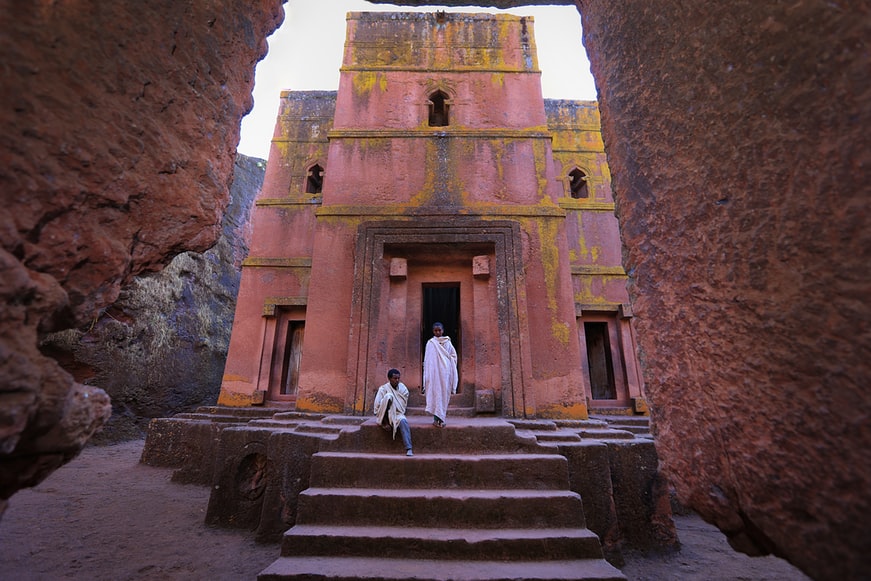
Deep in the rugged highlands of northern Ethiopia lies a place where faith and engineering merge in breathtaking harmony: the rock-hewn churches of Lalibela. Carved entirely out of living rock in the 12th century under the reign of King Lalibela, these 11 medieval monoliths are not merely buildings but sacred sculptures, each with its own unique design and purpose. The most iconic, Bet Giyorgis (St. George’s Church), resembles a Greek cross when viewed from above, its cruciform shape mirrored in the red volcanic tuff from which it was excavated. Unlike traditional construction, these churches were hewn downward from the top, with workers removing millions of tons of stone to create aisles, altars, and even underground passageways. The interiors are adorned with vibrant frescoes depicting biblical scenes, their colors vivid despite the passage of centuries. Pilgrims and travelers alike are struck by the spiritual ambiance here, where the scent of incense mingles with the cool mountain air, and the echoes of chanting priests drift through the labyrinthine corridors. Lalibela is not just a destination; it is a pilgrimage into the heart of Ethiopia’s unyielding Christian heritage.
The Swahili Coast: A Melting Pot of Trade and Culture
Stretching from Somalia to Mozambique, the Swahili Coast is a living testament to the vibrant cultural synthesis that flourished along the Indian Ocean trade routes. For over a thousand years, this coastal ribbon has been a crossroads where Arab, Persian, Indian, and African influences intertwined, leaving behind a legacy of coral-stone cities, dhows gliding across turquoise waters, and a language—Swahili—that is a linguistic palimpsest of borrowed words and indigenous roots. Stone Town in Zanzibar, a UNESCO World Heritage Site, is the crown jewel of this maritime heritage. Its labyrinthine alleys wind past intricately carved wooden doors, some inlaid with ivory and brass, a symbol of the wealth amassed by Omani sultans and Indian merchants. The House of Wonders, once the tallest building in East Africa, stands as a relic of Sultan Barghash’s modernization efforts in the late 19th century. Equally captivating are the ruins of Gede, a Swahili settlement abandoned in the 17th century, where baobab trees rise like sentinels over crumbling mosques and palaces, their roots intertwining with the remnants of a once-thriving society. Here, the past is not confined to museums; it breathes in the salty tang of the ocean and the rhythm of the tides.
Great Zimbabwe: The Silent Citadel of a Forgotten Empire
Rising from the savanna like the spine of some primordial beast, the ruins of Great Zimbabwe are a haunting reminder of a civilization that once dominated southern Africa. Built between the 11th and 15th centuries by the Shona people, this sprawling complex of stone walls, towers, and enclosures was the political and economic heart of the Kingdom of Zimbabwe, a realm that traded gold, ivory, and copper across the Indian Ocean. The Great Enclosure, the largest ancient structure south of the Sahara, is a marvel of dry-stone masonry, its walls constructed without mortar yet standing firm after centuries of erosion and seismic activity. The acoustics within the enclosure are such that a whisper can travel unnaturally far, a phenomenon that has led some to speculate about the site’s acoustic properties being used for ceremonial purposes. The name “Zimbabwe” itself means “stone houses,” and the site’s grandeur—with its conical towers and terraced walls—challenges the colonial-era myth that Africa lacked the sophistication to build such structures. Today, Great Zimbabwe is a symbol of African resilience, its stones echoing with the stories of kings, traders, and commoners who once walked its paths.
The Rock Art of the Tassili n’Ajjer: Prehistoric Masterpieces in the Sahara
In the heart of the Sahara Desert, where the dunes shift like the tides of an endless sea, lies Tassili n’Ajjer, a UNESCO-listed plateau adorned with some of the most extraordinary prehistoric rock art in the world. These paintings and engravings, dating back as far as 10,000 BCE, depict a lost world where giraffes, elephants, and hippos roamed a lush, green landscape teeming with life. The art is not merely decorative; it is a visual chronicle of climate change, human migration, and the evolution of early societies. One of the most famous panels, the “Round Head” style, features enigmatic figures with exaggerated heads and bodies, their meaning lost to time but their presence undeniable. The colors—ochre reds, chalk whites, and charcoal blacks—have retained their vibrancy despite the harsh desert environment, a testament to the skill of the artists who used natural pigments and binding agents like egg and animal fat. Tassili n’Ajjer is more than an archaeological site; it is a portal to a time when humans and nature existed in a delicate balance, a reminder that even the most arid landscapes were once teeming with stories.
Fes el-Bali: The Medieval Soul of Morocco
Few places on Earth encapsulate the essence of medieval Islamic civilization as vividly as Fes el-Bali, the ancient medina of Fez in Morocco. Founded in the 9th century, this labyrinthine city is a UNESCO World Heritage Site, its narrow alleys too narrow for cars, where the scent of leather tanneries mingles with the aroma of freshly baked msemen (Moroccan pancakes) and the call to prayer echoes off the ochre walls. At its heart lies the Al Quaraouiyine University, founded in 859 CE, recognized by UNESCO as the world’s oldest existing educational institution. The university’s library, with its 4,000 manuscripts including a 9th-century Quran written in Kufic script, is a treasure trove of knowledge. Equally mesmerizing are the Chouara Tanneries, where workers still use traditional methods to dye leather in vibrant hues, their vats arranged in a geometric pattern that has remained unchanged for centuries. Fes el-Bali is not just a relic; it is a living city where the past and present coexist, where artisans practice trades passed down through generations, and where every corner tells a story of trade, scholarship, and spiritual devotion.
Ouidah: A Portal to the Transatlantic Slave Trade
On the coast of Benin, the town of Ouidah stands as a solemn monument to one of humanity’s darkest chapters: the transatlantic slave trade. Once a major port for the Kingdom of Dahomey, Ouidah became a hub where European slavers, African middlemen, and local rulers orchestrated the forced migration of millions. Today, the town is a place of remembrance, where the past is not buried but confronted. The Door of No Return, a symbolic gateway on the beach where enslaved Africans were loaded onto ships, is a stark reminder of the final step in a journey that began hundreds of miles inland. Nearby, the Temple of Pythons honors the voodoo deity Dangbé, a syncretic faith that emerged from the fusion of African traditions and Catholicism. The Ouidah Museum of History, housed in a former Portuguese fort, chronicles the town’s role in the slave trade with unflinching honesty, its exhibits including shackles, trading ledgers, and personal accounts of survivors. Visiting Ouidah is not an easy experience, but it is a necessary one—a confrontation with history that demands reflection and, ultimately, a commitment to ensuring such atrocities are never repeated.