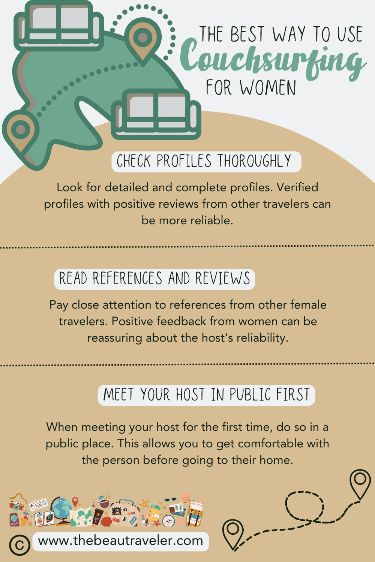
Couchsurfing offers women an affordable gateway to authentic travel, yet the platform’s open‑door nature constantly raises safety concerns. While many travelers share the same surface‑level observation—“I’m nervous about staying with a stranger”—the underlying fascination stems from a deeper desire for genuine cultural immersion, community trust, and personal empowerment. Below is a practical safety script designed to protect women without compromising the spirit of adventure.
1. Verify Profiles Thoroughly
Before reaching out, examine every detail on a host’s profile. Look for a verified ID badge, multiple recent photos, and a history of positive references. Cross‑check the host’s social media presence when possible. A well‑documented profile reduces the likelihood of fraudulent accounts and signals a genuine commitment to the Couchsurfing community.
2. Initiate Communication on the Platform
All initial messages should remain within Couchsurfing’s messaging system. This ensures that conversations are logged and can be reviewed later if any concerns arise. Avoid exchanging personal phone numbers or email addresses until you are confident about the host’s reliability.
3. Set Clear Boundaries Early
State your expectations regarding sleeping arrangements, gender‑specific spaces, and daily routines in the first exchange. Clear, upfront communication prevents misunderstandings and establishes a mutual respect framework, which is essential for both safety and comfort.
4. Conduct a Background Check
When possible, request a reference from a previous guest or ask the host for additional verification, such as a copy of a passport or driver’s license. While hosts are not obligated to provide this, many who care about safety are willing to share extra documentation.
5. Arrange a Public Meet‑up First
If you feel uneasy about heading straight to a private residence, suggest meeting at a café, park, or coworking space for a brief introductory chat. This neutral environment allows you to assess the host’s demeanor and gauge whether you feel comfortable proceeding.
6. Share Your Itinerary with Trusted Contacts
Provide a trusted friend or family member with your host’s name, address, and expected check‑in/out times. Use the “Trip” feature on Couchsurfing to log your journey, and enable location sharing on your smartphone for added peace of mind.
7. Keep Essential Items Accessible
Carry a small bag with personal items such as a toothbrush, lockable suitcase, spare set of keys, and a basic first‑aid kit. Having a self‑contained kit ensures you can maintain personal hygiene and health standards without relying solely on the host’s provisions.
8. Know the Exit Strategy
Plan an exit route before bedtime. Identify the nearest public transportation options, 24‑hour taxi services, or rideshare availability. Understanding how to leave quickly if you feel unsafe is a crucial component of any safety script.
9. Trust Your Instincts
Women frequently cite a “gut feeling” as a decisive factor in their travel choices. If something feels off—whether it’s the tone of a message, the host’s response time, or an ambiguous address—don’t hesitate to cancel the stay and look for an alternative.
10. Document the Stay
Take discreet photos of the entryway, bedroom, and any shared spaces upon arrival. This documentation can serve as evidence should an issue arise, and it also creates a visual record for future guests seeking transparency.
11. Use the “Verified Host” Badge Wisely
While a verified badge is not a guarantee of safety, it indicates that the host has passed basic identity checks. Prioritize these hosts when possible, especially in regions where personal safety is a known concern.
12. Participate in the Community Post‑Stay
Leave an honest review after your stay—highlight both the positive aspects and any safety concerns. Future travelers benefit from your insight, and hosts receive constructive feedback that can improve their hosting practices. A robust review system reinforces accountability across the platform.
13. Understand Cultural Norms
Fascination with Couchsurfing often stems from a desire to experience local lifestyles firsthand. Recognize that social customs vary widely; a behavior that feels invasive in one culture may be benign in another. Conduct brief research on local gender norms to avoid misinterpretation and to adapt your safety script accordingly.
14. Keep a Digital Copy of Important Documents
Store scanned copies of your passport, travel insurance, and emergency contact list in a secure cloud folder. In the event of a lost or stolen phone, you’ll still have access to critical information needed for identification and assistance.
15. Choose Hosts with Similar Travel Objectives
Aligning your travel purpose—whether it’s language practice, culinary exploration, or sightseeing—with a host’s interests fosters natural conversation and reduces the chance of awkward or intrusive interactions. Shared goals create a collaborative environment where safety is an implicit priority.
16. Practice Minimal Disclosure
Only share information that is necessary for the stay. Details such as your exact flight number, personal financial data, or full itinerary are not required for a successful host‑guest relationship and can expose you to unnecessary risk.
17. Stay Updated on Local Safety Alerts
Monitor news outlets and government travel advisories for the region you are visiting. Awareness of recent incidents—such as protests, natural disasters, or crime spikes—allows you to adjust your safety script in real time, for example by opting for a different host or staying in a hotel temporarily.
18. Empower Yourself Through Knowledge
The deeper allure of Couchsurfing lies in its promise of empowerment through cultural exchange. By mastering safety protocols, women transform potential vulnerabilities into confidence, turning each stay into a secure, enriching experience.